

A network of projects connecting knowledge and climate action
A priority for the initiative since 2008, Brazil currently has 44 projects, implemented by 20 organizations, in partnership with 10 Brazilian ministries.


A country of continental dimensions, marked by the diversity of biomes, territories and institutional realities. It is in this context that the IKI Interface Brazil operates, created in 2017 on behalf of the German Federal Ministry of the Environment, Climate Action, Nature Conservation and Nuclear Safety (BMUKN) and implemented by the Deutsche Gesellschaft für Internationale Zusammenarbeit (GIZ) to strengthen the articulation between the projects of the International Climate Initiative (IKI) with governments, civil society organizations, research institutions and international partners.
A priority for the initiative since 2008, Brazil currently has 44 projects, implemented by 20 organizations, in partnership with 10 Brazilian ministries, totalling 245 million euros in investments.
The IKI Interface has consolidated itself as a platform for connection, learning and knowledge management, bringing together the IKI projects in Brazil and creating conditions for experiences, knowledge and solutions to circulate between different initiatives. In 2024, this work took a new step with the launch of the Climate Change Policies II Program (PoMuC II), which continues the work of the IKI Interface.
"The main objective of the IKI Interface in Brazil is to strengthen the IKI community in the country, promoting collaboration between projects, implementing organizations, the Brazilian and German governments and other strategic partners," explains Carolina Coelho, IKI's communication advisor in Brazil.
IKI Brazil's work is based on a simple finding: projects that work with similar themes, even if in different territories or scales, can produce greater results when they share experiences and learning. "The goal is to build a community of practice capable of strengthening collective learning and generating more integrated solutions to climate and biodiversity challenges," says Carolina Coelho.
This vocation gained concrete expression at the 9th Annual Meeting of IKI Brazil, held in Brasilia, in May 2026. With the theme "Cooperation in networks: implementing in networks transforms cooperation into impact", the meeting deepened the integration strategy of the Brazilian portfolio, stimulating the construction of common narratives, collective learning and new forms of articulation between projects.
For Andreas Kübler, Head of Division at BMUKN, this trajectory demonstrates the strength of cooperation between the two countries. "Germany is proud to contribute to the preservation of Brazilian ecosystems. Nature does not need humans, but humans need nature.", he said in a statement during the meeting.
One of the main results was the creation of five Communities of Practice (CoPs), dedicated to strategic themes: collaboration with the private sector; gender and PIQCTs (indigenous peoples, quilombolas and traditional communities); communication for climate and biodiversity; use of artificial intelligence in IKI projects and multilevel governance. The expectation is that, over the next few months, the groups will consolidate their agendas and present the first results at the 10th IKI Brazil Meeting, in 2027.
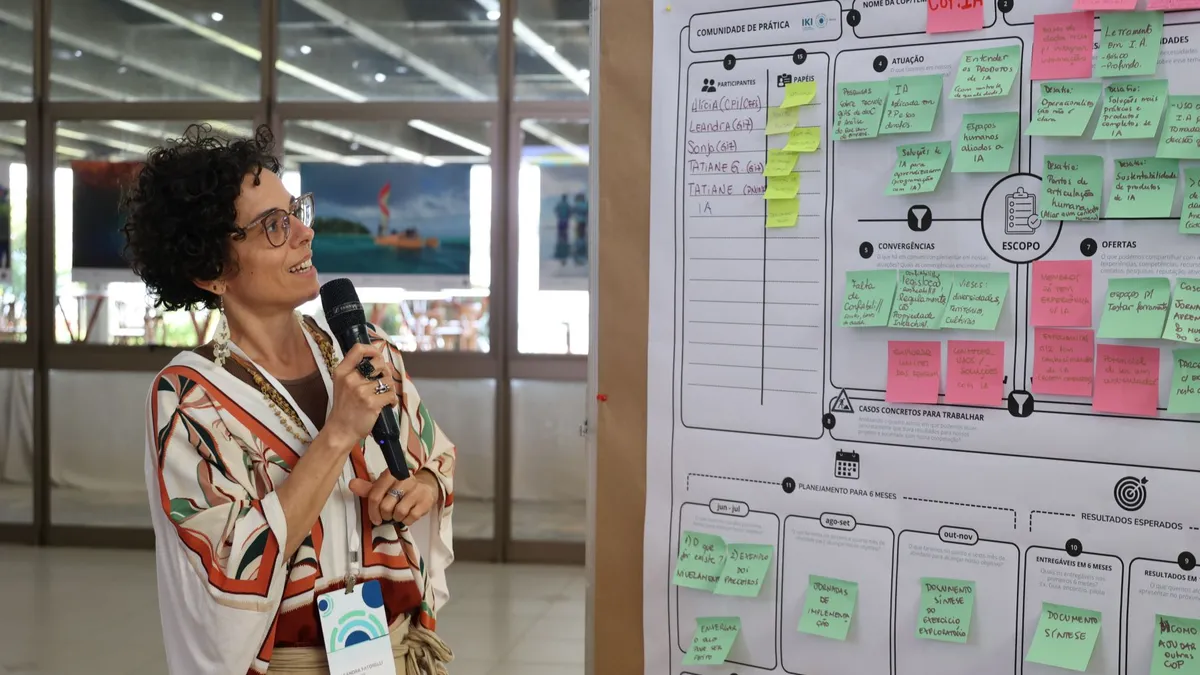
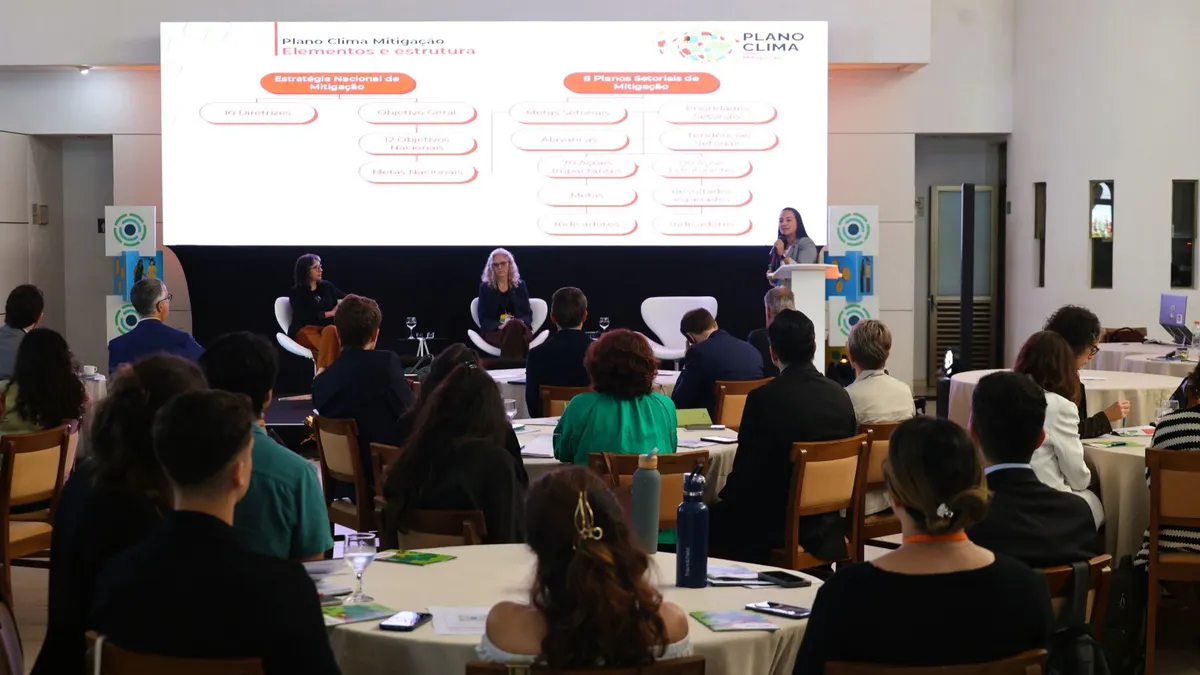
Networking was the keytopic at the 2026 Annual Meeting, also when IKI projects learned about the Brazilian Climate Plan, an instrument coordinated by the Brazilian federal government that brings together the goals and actions that will guide Brazilian policies for mitigation and adaptation to climate change until 2035 and that serves as a basis for updating the country's Nationally Determined Contribution (NDC).
The presentation of the Climate Plan, led by the directors Marcela Aboim, Inamara Melo and Lidiane Melo, from the National Secretariat for Climate Change of the Ministry of Environment and Climate Change (MMA), made it possible to bring international projects closer to national priorities and identify possible entry points for cooperation.
Through PoMuC II, the IKI Interface maintains a close dialogue with government ministries and institutions, contributing to strategic processes related to the implementation of climate policies, the strengthening of institutional capacities, and the preparation of the country for international frameworks.
Translating the global to the territory
If the articulation between projects and government is a strategic front, communication becomes another fundamental axis of the IKI Interface. The strategy combines newsletters, digital platforms, social networks, videos, campaigns, events and editorial content. This IKI Conecta magazine, IKI News Brasil and the IKI Brasil website are examples of channels created to increase the visibility of the projects and share knowledge produced by the portfolio.
"The objective is to show that international goals are achieved through local initiatives that generate real benefits for people, communities and ecosystems", explains Carolina Coelho.
Among the initiatives developed in this field are the Climate Plan 2024 - 2035 Booklet, which translates technical information from the main instrument of Brazilian climate policy into an accessible language, and the Climate Communication Guide, designed to bring the global agenda closer to the Brazilian reality.
One of the most emblematic results of this integration effort is the IKI Brazil Manifesto, built collectively with representatives of the projects, partners and institutions that make up the IKI network in Brazil. Prepared from interviews and a co-creation workshop held during the 9th IKI Brazil Meeting, the document brings together values, principles and contributions shared by the IKI community in the country.
"Creating permanent spaces for dialogue, promoting trust between partners and investing in strategic communication strengthens results much more than isolated actions", says the communication advisor. For her, sharing experiences between projects can generate innovation, avoid duplication of efforts and expand the collective impact of the initiatives supported by IKI.
